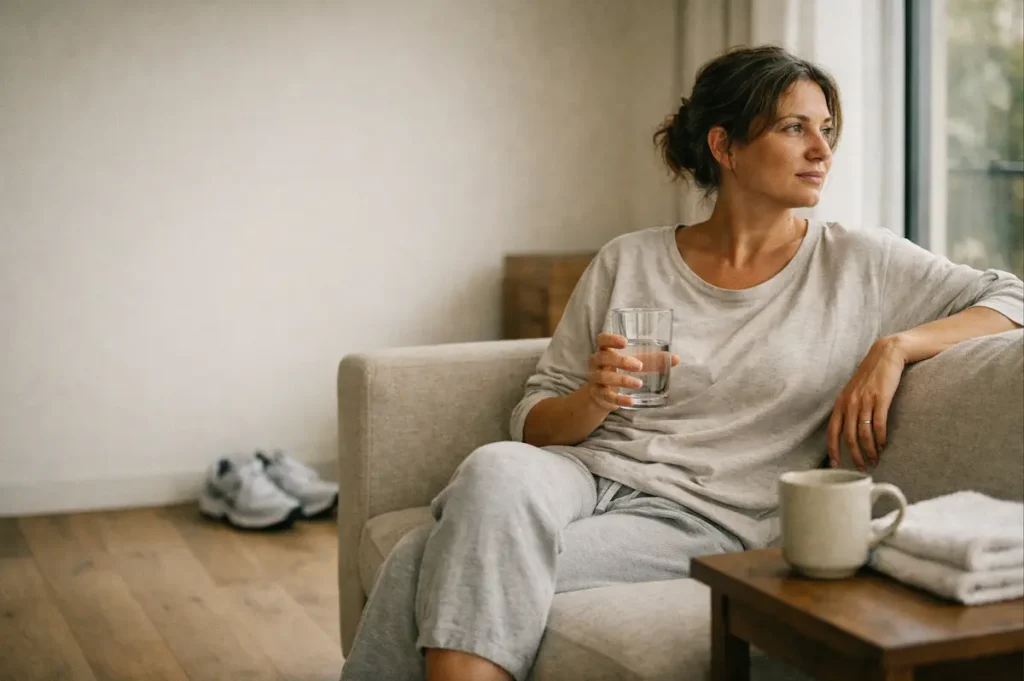
The truth is: good massage aftercare isn’t complicated – but the right choice depends on what kind of massage you had (relaxation vs sports vs deep tissue), how your body reacted, and what you’re doing in the next 24 hours.
If you’re feeling sore or heavy afterwards, that’s more common after deep tissue massage or a targeted sports massage – and it typically settles within 24–48 hours.
This guide covers exactly what to do after a massage (and what to avoid), including aftercare for sports massage, aftercare for deep tissue massage, and whether you can exercise after a massage.
⚡ Quick Answer / TL;DR
What should I do after a massage? For most people, the best aftercare is simple: hydrate steadily, eat normally, keep movement gentle, and avoid hard training and alcohol for 12–24 hours (especially after deep tissue or sports massage).
Best default plan: Drink ~500ml of water over the first hour, take a short walk, do light mobility (not intense stretching), and aim for an early night.
Avoid today: max-effort workouts, aggressive stretching/rolling, and heavy drinking (they tend to make soreness hang around longer).
Exercise? You can exercise after a massage if it was light/relaxation and you feel good – but after sports or deep tissue work, most people do better with active recovery for 12–24 hours.
Not sure how “deep” it was? See sports massage vs deep tissue.
A simple rule-based guide (so you don’t overthink it)
- If you feel tender/sore: treat the next 24 hours like active recovery (walk + light mobility).
- If it was a light relaxation massage and you feel great: normal day is fine; easy exercise is usually OK.
- If the massage was deep or very specific: avoid max-effort lifting/intervals for 12–24 hours.
- If you get new nerve symptoms (numbness/tingling/weakness) or escalating pain: stop and check in with a clinician.
Quick definitions (in plain English):
- Active recovery: gentle movement that helps you recover without adding extra stress (walking, easy cycling, light mobility).
- DOMS: delayed-onset muscle soreness – the “day after gym” tenderness feeling.
- Nerve symptoms: numbness, tingling, or weakness (different from normal muscular soreness).
Massage aftercare checklist
Simple answer: After a massage, keep hydration steady, keep movement gentle, and avoid piling extra stress onto your body straight after treatment.
- Hydrate steadily (don’t chug a huge amount at once)
- Walk for 10–20 minutes to keep circulation moving
- Eat normally (especially if you’re active)
- Avoid alcohol for 12–24 hours if possible
- Prioritise sleep that night
What you might feel after a massage (normal): mild tenderness, sleepiness, light-headedness, feeling “spaced out”, or a temporary increase in soreness in the worked areas. Noticing marks afterwards can be worrying too – here’s what bruising after massage usually means, and when to get it checked.
Not normal: sharp or escalating pain, new nerve symptoms (numbness/tingling/weakness), significant swelling, or feeling unwell that keeps worsening.
If headache is your main symptom: see Headache After Massage: Why It Happens and What Helps.
Massage aftercare (the principles that work for most people)
If you take nothing else from this guide, take this: massage is a stimulus. Sometimes it feels relaxing, sometimes it feels intense – but either way, your body does best when you support recovery rather than stacking more stress on top of it.
- Hydration helps (especially if you arrived a bit dehydrated)
- Gentle movement helps (walking is one of the best “default” options)
- Sleep helps (it’s when a lot of repair and nervous-system recovery happens)
- More pressure isn’t always better (soreness isn’t a badge of honour)
- Don’t chase the “loose” feeling with extra stretching or heavy training straight away
What to do after a massage: a simple decision guide
Quick decision: Light massage + you feel fine = normal day is OK. Deep/specific massage or tenderness = treat it like a recovery day for 12–24 hours.
If your massage was…
- Relaxation / Swedish: normal day is fine; easy exercise is usually OK if you feel good.
- Sports massage: treat it like recovery support; keep training easy for 12–24 hours if the work was deep or specific.
- Deep tissue: expect mild soreness; plan a recovery-style day and avoid max effort work for 24 hours.
- Lymphatic drainage: hydrate steadily, keep movement light, and avoid overheating if you feel light-headed.
- Self-massage or pressure point work: generally gentler than professional treatment; hydrate normally and avoid aggressive follow-up stretching. See foot pressure points for technique guidance.
What to do after a massage: the ideal 0–24 hour plan
Simple timeline: In the first hour hydrate + walk. For the rest of the day keep movement easy, avoid max effort training, and prioritise sleep.
0–2 Hours After
- Drink water steadily (avoid “chugging” a huge amount all at once)
- Move gently for 10–20 minutes (a short walk is perfect)
- Eat normally if you’re hungry (don’t “skip food” to be virtuous)
- Keep the rest of your day light if you can
2–6 Hours After
- Gentle mobility (hips, ankles, thoracic spine, shoulders)
- Warm shower if you feel stiff (not scalding hot)
- Normal activity is fine – avoid max effort training
6–24 Hours After
- Prioritise sleep (this is when a lot of recovery happens)
- Keep training easy (Zone 2 cardio, light strength work, mobility)
- Notice soreness – mild tenderness is normal; sharp pain isn’t
Why do you feel tired after a massage?
Feeling unusually sleepy after a massage is very common – and usually nothing to worry about. For many people, massage downshifts the nervous system (especially if you’ve been stressed, tense, or sleeping poorly), and that shift can feel like a sudden “energy drop”.
It’s also normal to feel a bit heavy or foggy after deeper work, simply because your body is processing a strong physical input. In most cases, it settles within a few hours – and an early night genuinely helps.
If you feel tired + unwell and it keeps worsening (fever, increasing nausea, swelling, new nerve symptoms), check in with a clinician.
What to do after a sports massage
Best approach: After a sports massage, prioritise hydration, a proper meal, and light movement – then keep training easy for 12–24 hours if the work was deep or targeted.
If you searched what to do after a sports massage, you’re probably either training regularly or managing a niggle. Sports massage is often more specific and more intense than a relaxation massage – it’s designed to influence muscle tone, movement quality, and tissue sensitivity.
- Walk for 10–20 minutes to keep blood moving
- Eat a proper meal with protein and carbs (especially if you’re active)
- Keep training sub-max for 12–24 hours if the work was deep
- Expect mild tenderness in targeted areas (glutes, calves, quads, back)
Many people feel “looser” after sports massage – but that doesn’t always mean your tissues are ready for a performance session. Feeling mobile and being fully recovered are not the same thing.
“After a sports massage, I tell clients to think ‘recovery first’. A gentle walk, a decent meal, and an early night will usually do more for performance than trying to force a hard session straight afterwards.”
– Sarah P, Sports Massage Therapist based in Telford
Related: If you train regularly, you might also like How Often Should You Get a Sports Massage? and What to Wear to a Sports Massage.
What to do after a deep tissue massage
Best approach: After deep tissue massage, expect mild soreness, keep movement easy, avoid intense stretching, and skip max-effort training for 24 hours.
Quick refresher: What Is a Deep Tissue Massage? (what it is, who it’s for, and what “deep” should feel like).
Deep tissue massage often involves slower pressure, deeper work into tight muscles, and more “intense” sensation. That means the aftercare matters more.
- Plan for mild soreness (like a light gym DOMS feeling)
- Avoid intense stretching immediately after (your tissues can be sensitive)
- Skip alcohol for 24 hours if possible (sleep + hydration matter)
- Use heat gently (warm shower or a light heat pack)
- Keep movement easy (walking, light cycle, gentle mobility)
“Deep tissue work can leave people feeling like they’ve trained hard – even if they’ve done nothing all day. Treat it like a recovery session: hydrate, move gently, and don’t chase intensity until your body has settled.”
– Mark L, Deep Tissue Massage Therapist in Long Eaton
The day after deep tissue massage
Best approach: Treat the next day like an active recovery day – easy movement, light mobility, no max lifting or intervals.
The day after a deep tissue massage, it’s normal to feel tender in the areas that were worked. If you train, treat it like an “active recovery day”: easy movement, light mobility, and avoid max effort lifting or intervals.
Is it normal to feel worse after deep tissue massage?
It can be: mild soreness, heaviness, or fatigue for 24–48 hours is common after deep work – it usually settles as your nervous system and local tissues calm down.
If you feel sharp pain, new nerve symptoms, unusual swelling, or symptoms that keep escalating, speak to your therapist and consider checking in with a healthcare professional.
Can you exercise after a massage?
Yes – but match the workout to the massage. After a light massage, many people can train normally if they feel good. After deep tissue or targeted sports massage, most people do best with active recovery for 12–24 hours.
This is one of the most searched questions: can you exercise after a massage?
If you do train after a massage, keep it sub-max: aim for 60–70% effort – technique-focused work, easy cardio, and leaving plenty in the tank.
Quick tip: If the massage was on your legs, avoid loading them heavily the same day.
Before the table below: Here’s the simplest way to decide if exercise after a massage is a good idea.
| Massage Type | Exercise same day? | Best option | What to avoid |
|---|---|---|---|
| Relaxation / Swedish | Usually yes (if you feel good) | Easy run, gym technique work | Max lifts, hard intervals |
| Sports massage | Sometimes | Walk, mobility, Zone 2 | Speedwork, heavy leg day (if targeted work) |
| Deep tissue | Often not ideal | Recovery day, light movement | HIIT, CrossFit, big compound lifts |
Can you drink alcohol after a massage?
Best approach: If you can, wait 12–24 hours – especially after deep tissue. Alcohol can worsen dehydration and sleep, which can make you feel more sore or foggy.
People commonly ask can you drink alcohol after a massage because they want to know if it will “undo” the session.
- Best case: skip alcohol for 12–24 hours (especially after deep tissue)
- If you do drink: keep it light, drink water alongside it, and prioritise sleep
- Most common issue: people feel more sore or “foggy” the next day
What to do after a lymphatic drainage massage
Best approach: After lymphatic drainage, hydrate steadily, keep movement light (walking), and avoid overheating if you feel light-headed.
After lymphatic drainage, the session is usually gentle and focused on fluid movement rather than deep tissue work.
- Hydrate steadily through the rest of the day
- Keep movement light (walking is ideal)
- Avoid very hot baths/saunas if you feel light-headed
- Keep your day low-stress where possible
Massage aftercare: what to avoid
The biggest mistakes: hard training too soon, aggressive stretching/rolling, and alcohol (because it disrupts hydration + sleep).
- Hard training within 12–24 hours (especially after deep tissue)
- Aggressive stretching when tissues feel tender
- Self-massage overload (foam roller + massage gun + stretching = too much)
- Alcohol (can worsen sleep and recovery)
- Very hot baths/saunas if you feel light-headed or drained
If you use a massage gun: here’s a practical guide on benefits, risks, and how to use one safely.
Hydration, “toxins”, and other massage myths
Do you need to drink loads of water after a massage?
No – just hydrate normally. Drink a bit extra if you arrived dehydrated, but overdoing water doesn’t “flush” anything and can make you feel off.
Practical target: drink roughly 500ml in the first hour, then continue normally through the day.
Does massage “release toxins”?
Not in the way people mean it. Massage can influence circulation, fluid movement, and your nervous system – but “toxins leaving the body” isn’t a useful model.
If you want a clear explanation, see: Do massages release toxins? (clear explanation)
When to contact your therapist or seek medical advice
Most post-massage effects are mild and short-lived. That said, it’s sensible to treat new or worsening symptoms seriously.
⚠️ When to seek medical help
Contact NHS 111 or your GP if:
- Symptoms last longer than 72 hours
- You have increasing pain rather than settling soreness
- You develop fever, flu-like symptoms, or unusual swelling
- You experience persistent dizziness or nausea
- You have new nerve symptoms (numbness, tingling, weakness)
Call 999 immediately if:
- Chest pain or breathlessness
- Sudden severe headache with confusion
- Face droop, slurred speech, collapse
- Severe allergic reaction symptoms
Frequently asked questions
What should you do immediately after a massage?
Hydrate steadily, walk for 10–20 minutes, and keep the rest of your day light if the treatment was deep or targeted. Most people feel best when they avoid over-stretching and prioritise sleep that night.
What should you do after a sports massage to recover faster?
Eat a proper meal, hydrate normally, and keep movement light. If the work was deep or targeted, avoid hard sessions for 12–24 hours and treat the day like active recovery.
What should you do after a deep tissue massage if you feel sore?
Keep moving gently, use heat lightly if it feels good, and avoid intense stretching or max-effort training. Mild soreness for 24–48 hours is common after deep work.
Can you exercise after a massage?
Yes – if the massage was light and you feel good. After sports or deep tissue massage, most people do better training easy (or waiting 12–24 hours) to avoid prolonging soreness.
How long should you rest after a massage?
After deep tissue or sports massage, aim for a lighter day and a good night’s sleep. Most post-massage tenderness settles within 24–48 hours.
Can massage help sciatica symptoms?
Sometimes — especially when symptoms are influenced by muscle tension, irritation, or movement restriction. Massage won’t fix structural causes like disc issues, but it can reduce pain and improve comfort for many people. See: Does Massage Help Sciatica?
Summary
- After a massage: hydrate, move gently, and keep stress low.
- Aftercare: don’t overdo stretching, heat, or intense training right away.
- Sports massage: treat it like recovery support – don’t rush intensity.
- Deep tissue: expect mild soreness and prioritise sleep.
- Alcohol: better to avoid for 12–24 hours if possible.
Medical disclaimer: This article is for educational purposes and is not a substitute for medical advice.