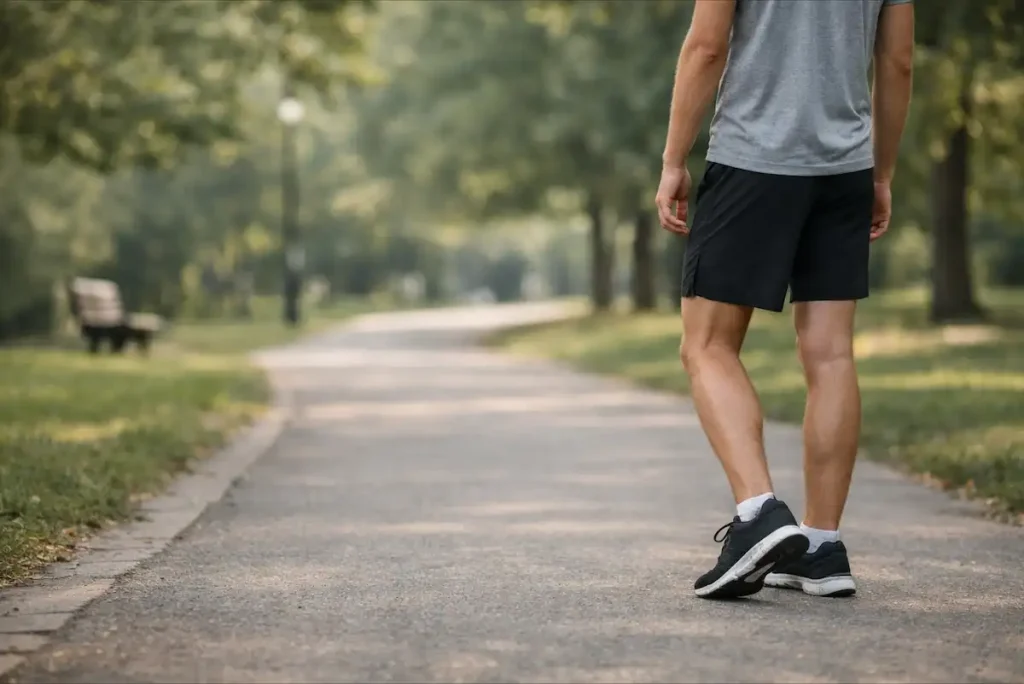
Scope: Runner-focused guidance on using sports massage and deep tissue massage for shin splints (often called medial tibial stress syndrome). The same principles apply if your shin pain comes from walking, standing, gym training, or sport.
Bottom line: Massage can help shin splints feel better short-term – mainly by reducing lower-leg tension and pain sensitivity – but lasting improvement usually comes from managing training load and rebuilding calf/tib capacity.
Reassurance: Most runners with shin splints improve without scans or surgery when the load spike is addressed and lower-leg strength is rebuilt gradually. The key is making sure it’s not a bone stress injury.
⚡ Quick Answer / TL;DR
Does massage help shin splints? Often, yes – short-term. It can reduce pain sensitivity, calm protective tension, and make walking/running more comfortable – especially when focused on the calf/soleus and the muscles that pull on the shin.
Most helpful when: pain is diffuse (spread over a few cm), feels like an ache/tightness, improves as you warm up, and there’s no swelling/heat/redness.
Least helpful (or higher risk) when: you have pinpoint bone pain in one spot, pain at rest/night, pain that’s worsening week-on-week, a limp, or pain that feels “sharp” with hopping.
Best approach: Use massage to settle symptoms while you reduce the trigger load (often mileage spike, speed, hills, or hard surfaces) and rebuild calf/tib strength 2–3x/week.
Real-world pattern: Shin splints often feel okay during a run once you’re warm, then ache later that day or the next morning. That’s a classic “irritability and load” signal – not a sign you need to smash the shin harder.
What Shin Splints Usually Feel Like (Runner Pattern)
Shin splints is the everyday name for a common overload problem in runners – often labelled medial tibial stress syndrome (MTSS). It typically feels like a diffuse ache along the inner edge of the shin, especially after increases in training load.
Simple definition: Shin splints are usually an overload irritation of the structures around the tibia (shin bone), often linked to how the calf/soleus and other lower-leg muscles handle repeated impact. It sits on a spectrum: mild overload irritation at one end, and bone stress injury / stress fracture at the other.
Common signs it’s likely shin splints (MTSS)
- Diffuse pain along a section of the inner shin (not one precise point).
- It may ease as you warm up, then ache later after the run.
- Flare-ups follow a training spike (more miles, more intensity, hills, harder surfaces).
- Both shins can be affected (not always, but it’s common).
Important point: Shin pain deserves respect because it can sit on a bone-stress spectrum. If pain is pinpoint and persistent, don’t treat it like “tight calves”. Get it assessed.
Why runners get shin splints (in simple terms)
Shin splints often show up when your impact load increases faster than your lower legs can adapt. Common triggers include sudden mileage increases, returning after time off, adding speed or hills, switching surfaces, or changing shoes.
Evidence-informed note: Long-term improvement is more consistently linked to load management + progressive strengthening than passive treatments alone. Massage can support symptoms, but it doesn’t replace rebuilding capacity.
Massage vs stretching vs strengthening for shin splints
- Massage: best for symptom relief and reducing lower-leg guarding.
- Stretching: can reduce stiffness, but rarely solves shin splints alone.
- Strengthening: key driver of long-term improvement (calf/soleus + tib muscles).
- Best results: massage supports comfort; strength and load progression do the fixing.
“I’ve suffered with shin splints myself, so I empathise with how frustrating it can be! Fortunately, massage can really help, and paired with some tweaks to your running, it can stop shin splints from ruining your prep for an event or race.”
– James W, Sports Massage Therapist in Nottingham
Should You Get Massage for Shin Splints? (60-Second Decision)
- ✅ Massage is a good idea today if: shin pain is diffuse/achy, improves as you warm up, and there’s no swelling/heat and no limp.
- ⚠️ Massage can help, but only if you change load too: it settles for 24–72 hours, then returns immediately with the same training pattern.
- ❌ Skip massage and get assessed first if: pain is pinpoint in one spot, painful at rest/night, you can’t hop without sharp pain, there’s swelling/heat/redness, or symptoms are worsening week-on-week.
When Is It Safe to Run Again? (Simple Pain Rules)
- Pain during the run is ≤ 3/10 and doesn’t change your stride.
- Symptoms aren’t worse the next morning (this is your best “irritability” check).
- No limp afterwards and no steady deterioration across 7–10 days.
- Progress one variable at a time: distance or speed or hills.
Runner rule: If shin pain is getting worse week-on-week, treat it as a load vs capacity issue – and consider an assessment to rule out bone stress injury.
What Massage Can (and Can’t) Do for Shin Splints
Massage is often described as “breaking up adhesions” or “releasing fascia”. That language can be misleading.
In most shin splints scenarios, massage helps through three realistic mechanisms:
- Pain modulation: reducing pain sensitivity for a period of time.
- Improved movement comfort: the lower leg can feel easier to load temporarily.
- Down-regulating protective muscle tension: especially through the calf/soleus and the muscles around the shin.
What massage usually doesn’t do on its own:
- Reverse a bone stress injury
- Fix a training load spike
- Replace progressive strengthening
- Prevent recurrence if you keep repeating the same overload pattern
Useful mental model: Massage is a symptom tool. Strength + sensible load progression is the long-term solution.
What helps most (quick comparison)
| Tool | Best for | Typical timeframe | Common mistake |
|---|---|---|---|
| Massage | Reducing sensitivity + guarding | Hours to days | Digging into the shin bone edge |
| Load adjustment | Settling irritability | Days to 2 weeks | Either doing nothing (push through) or cutting everything |
| Strength | Long-term capacity + resilience | Weeks | Going too hard too soon (flare-ups) |
Where Massage Helps Most (Best Targets ✅)
Most runners do best when massage focuses on the muscles that influence tibial load – rather than aggressive work along the shin itself.
Best massage targets ✅
- Soleus + calf complex (often the biggest driver).
- Tibialis anterior (front of the shin) – treat muscle belly, not bone.
- Peroneals (outer lower leg) – commonly tight in runners.
- Foot intrinsics (gentle) if the foot feels guarded.
What to Avoid (Common Flare Triggers ❌)
What to avoid ❌
- Deep aggressive work along a painful shin bone edge (especially if pain is sharp or pinpoint).
- High-pain pressure when symptoms are flared (common cause of a 24–48 hour setback).
- “Scraping” techniques used too aggressively on an irritable shin.
Simple targeting rule: Treat muscle first (calf/soleus/tib muscles). If you touch the shin line at all, keep it light and broad – not pointy and deep.
How Deep Should Massage Be? (A Simple Pressure Scale)
A common mistake is assuming “more painful = more effective”. For shin splints, the opposite is often true.
- 2–4/10 pressure: flared symptoms, sensitive shins, uncertain diagnosis
- 5–7/10 pressure: stubborn calf tightness, stable discomfort
- 8–10/10 pressure: rarely necessary – higher risk of flare-ups
Rule: If symptoms flare for > 24 hours after treatment, reduce pressure by 2 points next time and move focus up into calf/soleus.
What “good” feels like after: easier walking, less guarded stride, and no “sharp” shin pain spike the next day.
7–14 Day Mini Plan (Massage + Load + Strength)
This is the “do the basics well” plan that works for a lot of runners with shin splints patterns.
1) Load changes (7–14 days)
- Reduce hard surfaces, speedwork, and hills temporarily.
- Keep runs easy + flatter. If symptoms are flaring, swap 1–2 runs for low-impact cardio temporarily.
- Avoid changing multiple variables at once (don’t add speed and distance in the same week).
2) Strength (2–3x/week)
- Slow calf raises: 3 x 8–12 (pain ≤ 3/10).
- Bent-knee calf raises to bias soleus.
- Tib raises (against a wall or band) 2–3 sets.
- Consistency matters more than one heroic session.
3) Massage role
- Reduce calf/soleus guarding and lower-leg tension.
- Keep pressure sensible – especially around the shin line when symptoms are flared.
If you only do one thing: Remove the load spike for 10–14 days and start calf/soleus strengthening. Massage supports this – it doesn’t replace it.
Self-Massage for Shin Splints (Ball, Roller, Massage Gun)
Self-massage can help for general tightness – but shin pain is easy to flare if you go too hard.
Self-massage works best when ✅
- Pain is diffuse and feels like tightness rather than sharp bone pain
- Symptoms improve as you warm up
- You use moderate pressure (think 4–6/10)
Be cautious / avoid when ❌
- You have pinpoint pain in one spot (possible bone stress injury)
- Pain is worse at rest or at night
- You flare for > 24 hours after self-treatment
Targeting rule: Spend most time on calf/soleus and the muscles around the shin – not repeatedly hammering the shin bone edge.
What to Expect in a Good Session (So You Don’t Waste Your Money)
- A quick symptom check: where it hurts, what changed in training, and whether pain is diffuse vs pinpoint.
- Pressure matched to irritability: light-to-moderate when flared; deeper only when stable.
- Muscle-first targeting: calf/soleus, tibialis anterior, peroneals – not deep work on the shin bone edge.
- Aftercare guidance: what to do for 24–48 hours to avoid a flare.
- No pain contest: effective is “better movement after”, not “destroyed for two days”.
What to Say to Your Therapist (Copy/Paste)
“I’ve got shin splints that started after I increased [mileage / speed / hills / surfaces]. Please keep pressure moderate, focus mainly on calf/soleus and the lower-leg muscles, and avoid aggressive deep work along the shin bone edge. I’m also reducing speed/hills temporarily and doing calf/tib strengthening.”
⚠️ When Massage Is a Bad Idea (Red Flags)
Speak to a clinician (or NHS 111) if you have:
- Pinpoint shin pain in one specific spot
- Night/rest pain that doesn’t settle
- Pain that’s worsening week-on-week
- Swelling, heat, redness, or a clear change in function
- Sharp pain with hopping or you can’t run without limping
- Recent injury with a “pop”, bruising, or inability to weight-bear
Frequently Asked Questions
Is massage good for shin splints?
Often, yes – short-term. It can reduce pain sensitivity and calm lower-leg tension, particularly through the calf and soleus. It works best alongside load management and strengthening.
Can massage make shin splints worse?
Yes. Aggressive deep work along a painful shin bone edge is a common flare trigger – especially if pain is sharp or pinpoint. Many runners do better with calf/soleus-focused work.
Where should you massage for shin splints?
Usually the calf/soleus first, then the muscle bellies of tibialis anterior and peroneals as needed. Avoid repeatedly digging into the shin bone edge.
How often should I get massage for shin splints?
For injury support: weekly or fortnightly sessions for a short block can help while you reduce the trigger load and rebuild strength. Once settled, many runners do well every 3–6 weeks for maintenance.
How do I know if it’s shin splints or a stress fracture?
General rule: shin splints are usually diffuse and improve as you warm up. Stress fracture pain is more likely to be pinpoint, persists at rest/night, and hurts sharply with hopping. If you’re unsure, get assessed – because bone stress injuries shouldn’t be pushed through.
Summary
In short: Massage can help shin splints by reducing pain sensitivity and muscle guarding, especially through the calf and soleus. It rarely fixes the problem alone. Lasting improvement usually comes from removing the load spike and rebuilding lower-leg strength gradually.
- Massage for shin splints can reduce discomfort short-term – mainly by calming lower-leg tension.
- Most runners improve faster when massage focuses on calf/soleus and lower-leg muscles, not aggressive work along the shin bone edge.
- If symptoms flare for > 24 hours after treatment, reduce pressure next time and treat muscle higher up the chain.
- For lasting change, pair massage with 10–14 days of load reduction and calf/tib strengthening 2–3x/week.
Related Guides (Recommended)
- Sports Massage vs Deep Tissue: How To Choose
- Massage for Runners: When It Helps (and When It Doesn’t)
- Massage for Shin Splints: Can It Help?
- Massage for Runner’s Knee: What Helps (and What to Avoid)
Medical Disclaimer: This article is for educational purposes and is not a substitute for medical advice.