
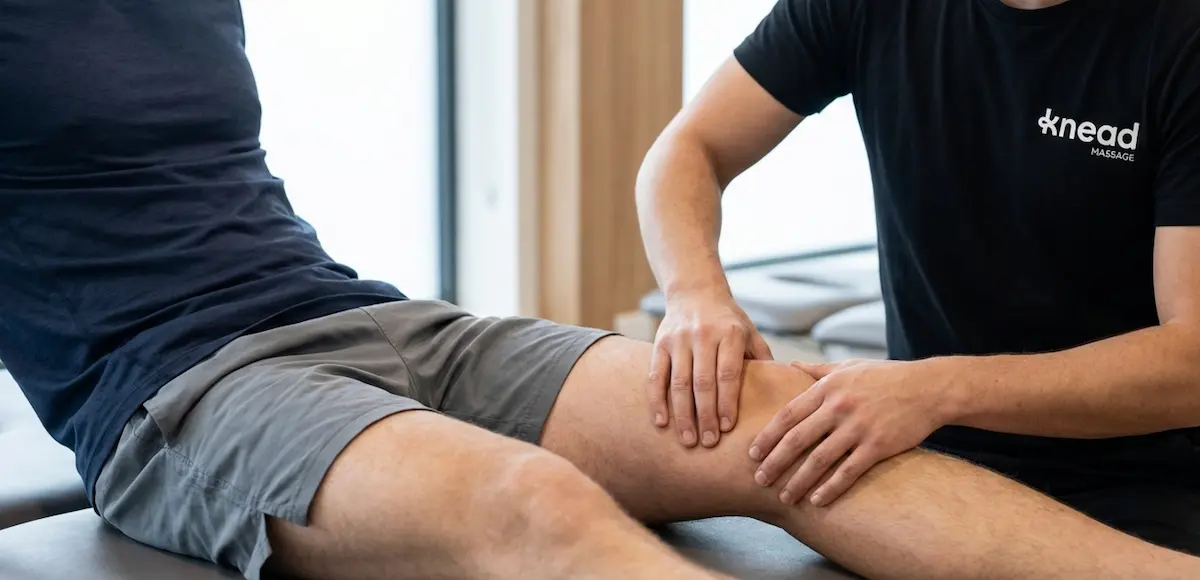
Scope: Runner-focused guidance on using sports massage and deep tissue massage for common knee pain patterns in runners – including runner’s knee (patellofemoral pain), IT band–type pain, and patellar tendon irritation. The same principles apply if your pain comes from walking, standing, gym training, or sport.
Bottom line: Massage can help runner’s knee feel better, but lasting improvement usually comes from managing running load and rebuilding strength around the knee and hips.
Reassurance: Most runners with knee pain improve without scans, injections, or surgery when training load is adjusted and strength is rebuilt gradually.
Knee pain is especially frustrating because it often feels “fine” one day and awful the next.
Simple definition: Runner’s knee (most commonly patellofemoral pain syndrome) refers to pain around or behind the kneecap that develops when running load exceeds the knee’s current capacity to tolerate and control force.
Who this article is for: Runners with gradual-onset knee pain that feels like a dull ache around/behind the kneecap or along the outer knee, especially if it builds during/after runs and is worse with hills, speed, or downhills.
Who this article is not for: Knee pain that started after a clear injury (twist, fall, collision), or symptoms like significant swelling/heat, locking, giving way, sharp focal pain, night/rest pain, or rapid worsening week-on-week – skip to the red flags section and get assessed.
⚡ Quick Answer / TL;DR
Does massage help runner’s knee? Often, yes – short-term. Massage can reduce pain sensitivity, ease muscle guarding, and make running or rehab feel more comfortable.
Most helpful when: pain is overload-related, feels stiff or achy, improves as you warm up, and there’s no major swelling or instability.
Least helpful (or higher risk) when: there’s sharp focal pain, swelling/heat, locking or giving way, night/rest pain, or symptoms worsening week-on-week.
Best approach: Use massage to settle symptoms while you temporarily reduce aggravating load (often hills, speed, or downhill running) and rebuild quad and hip strength.
Real-world pattern: Many runners feel relief after massage, then get frustrated when knee pain returns as soon as hills, speedwork, or longer runs come back in.
Runner’s Knee Symptoms in Runners
Runner’s knee is a broad, everyday term. Clinically, it often overlaps with:
- Patellofemoral pain (pain around or behind the kneecap)
- IT band–type pain (outer knee ache, often worse on downhills)
- Patellar tendon irritation (pain just below the kneecap)
Key idea: Most runner’s knee pain is an overload and tracking problem, not “damage”. The knee is coping… until the load (volume, speed, hills, fatigue) exceeds what the surrounding muscles can currently control.
Common signs it’s runner’s knee–type pain
- A dull ache around or behind the kneecap, or along the outer knee
- Pain that builds during or after runs, especially hills or downhills
- Discomfort with stairs, squats, sitting for long periods
- Symptoms that ease with warming up, then return later
Important point: If pain keeps returning as soon as you repeat the same training, it’s rarely because the knee itself is “tight”. It’s usually because strength and control haven’t caught up with the load.
What Causes Runner’s Knee in Runners?
The knee sits between two big force generators: the hip and the ankle. If hip control or quad capacity drops (fatigue, load spikes, or under-training), the knee often takes extra strain – especially during hills, speed, or downhill running.
Evidence-informed note: Strengthening (particularly quads and hips) and sensible load management are more strongly linked to long-term improvement than passive treatments alone.
Consensus framing: Current research consistently shows that education, progressive strengthening, and load management outperform passive treatments alone for long-term outcomes in patellofemoral pain. The NHS knee pain guidance covers when to get a knee checked.
Best Treatment for Runner’s Knee (What Actually Works)
Most runners improve fastest with two levers:
- Load management: temporarily reduce the most aggravating triggers (often hills, downhills, speedwork, or long runs), then reintroduce them gradually.
- Progressive strengthening: rebuild capacity in the quadriceps and hips so the knee can tolerate and control force again.
Where massage fits: Massage can help settle symptoms and improve comfort so you can keep moving and do your rehab with less irritation – but it works best as support, not as the main treatment.
Does Massage Help Runner’s Knee?
Yes – in the short term for many runners. Massage can reduce pain sensitivity and muscle guarding, which often makes running and rehabilitation exercises feel easier and more comfortable.
However: Massage does not increase the knee’s long-term load tolerance on its own. Without addressing training load and strength, symptoms often return.
Is Runner’s Knee Caused by Tight Muscles?
Usually not on their own. While muscles around the knee and hip may feel tight or sore, runner’s knee is more accurately described as a load management and strength capacity issue, rather than a pure flexibility problem.
Massage vs stretching vs strengthening for runner’s knee
- Massage: helpful for short-term pain relief and reducing muscle guarding
- Stretching: can improve comfort, but rarely fixes knee pain alone
- Strengthening: the main driver of lasting improvement (quads + hips)
- Best results: massage supports comfort; strength and load management drive recovery
“Massage can make a sore knee feel noticeably better, sometimes very quickly. The longer-term wins tend to come when runners also give the knee a bit of breathing room and build back strength around it.”
Should You Get Massage for Runner’s Knee? (60-Second Decision)
- ✅ Massage is a good idea today if: pain feels stiff/achy, improves as you warm up, and there’s no swelling or instability.
- ⚠️ Massage can help, but only if you change load too: pain settles for a day or two, then returns with the same hills, speed, or long runs.
- ❌ Skip massage and get assessed first if: knee locking, giving way, swelling/heat, sharp focal pain, night pain, or worsening symptoms week-on-week.
When Is It Safe to Run Again? (Simple Pain Rules)
- Pain during the run is ≤ 3/10 and doesn’t alter your stride.
- Symptoms aren’t worse the next morning.
- No limp afterwards and no steady deterioration over 7–10 days.
- Progress one variable at a time: distance or speed or hills.
Runner rule: If knee pain is escalating week-on-week, it’s usually a signal to step back slightly on load and step up strength – not to push through.
Clinical Summary
Runner’s knee is rarely caused by tight tissue alone. Massage can reduce pain sensitivity and muscle guarding, but lasting improvement depends on progressive load management and strengthening of the quadriceps and hip musculature.
What Massage Can (and Can’t) Do for Knee Pain
Massage is often described as “realigning” the knee or “breaking down tight tissue”. That’s not really how it works.
In runner’s knee patterns, massage helps mainly by:
- Pain modulation: reducing pain sensitivity
- Improving movement comfort: making running or rehab feel easier
- Reducing muscle guarding: especially in quads, hips, and calves
What massage usually doesn’t do on its own:
- Correct poor load tolerance
- Replace quad or hip strengthening
- Prevent recurrence if training errors persist
Useful mental model: Massage helps you feel better. Strength and load management help you stay better.
FAQ
Can massage make runner’s knee worse?
Yes, occasionally – especially if the therapist goes too deep, targets a very irritable tendon area, or you treat massage like “permission” to jump straight back into hills and speed. A good session should leave you feeling looser and calmer, not sharply sorer for days.
How often should I get massage for runner’s knee?
A common starting point is every 1–2 weeks for a short block (e.g. 2–4 sessions), while you adjust load and build strength. If you’re relying on frequent massage to keep symptoms at bay, that’s usually a sign the rehab and running load still need tightening up.
Should I stop running completely?
Not always. Many runners can keep some running if symptoms stay mild (e.g. ≤3/10), don’t change your stride, and aren’t worse the next morning. If pain is escalating, you’re limping, or the knee feels unstable, pause running and get assessed.
Summary
- Massage for runner’s knee can help reduce pain and muscle guarding.
- It works best when combined with load management and strength.
- Most runners who adjust load and rebuild strength see meaningful improvement within 6–12 weeks.
- Use massage to support rehab – not replace it.
Related Guides (Recommended)
- Sports Massage vs Deep Tissue: What’s Best for You?
- Massage for Running Injuries: When It Helps (and When It Doesn’t)
- Massage for Runner’s Knee: What Helps Knee Pain After Running
- Massage for Piriformis Syndrome: What Helps Deep Glute Pain (and What to Avoid)
Medical Disclaimer: This article is for educational purposes and is not a substitute for medical advice.