
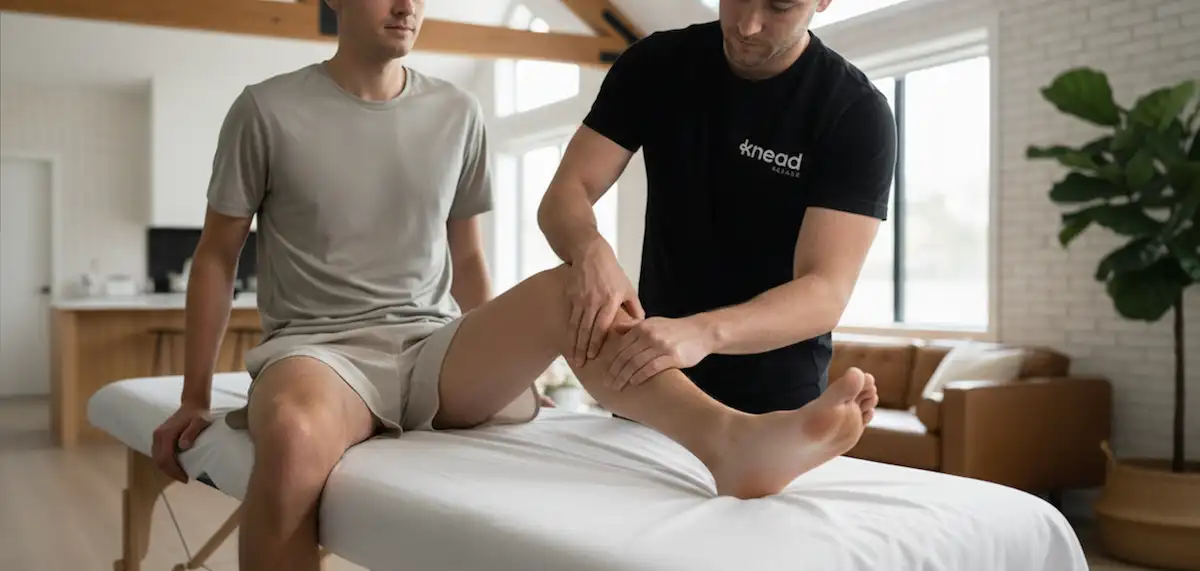
Scope: Runner-focused guidance on using sports massage and deep tissue massage for Achilles tendinopathy (Achilles pain/stiffness). The same principles apply if your Achilles is irritated from walking, standing, gym training, field sports, or hiking.
Bottom line: Massage can make Achilles tendinopathy feel better short-term, but lasting improvement usually comes from managing load and rebuilding calf capacity with progressive strengthening.
Reassurance: Most runners with Achilles tendinopathy improve without injections or surgery when training load is adjusted and calf/soleus strength is rebuilt gradually. The common mistake is treating the tendon like the enemy instead of rebuilding what loads it.
This is part of our running injuries series – for a broader overview, see our comprehensive guide to massage for running injuries.
Quick definition: Achilles tendinopathy is an overload condition where the Achilles tendon becomes painful and sensitive because training demand exceeds current calf–tendon capacity.
When NOT to do this: Massage is not appropriate for suspected Achilles rupture, rapidly worsening swelling, or severe pain at rest/night. If in doubt, get assessed first.
⚡ Quick Answer / TL;DR
Does massage help Achilles tendinopathy? Often, yes – short-term. It can reduce pain sensitivity, calm protective tension, and improve movement comfort (especially when focused on the calf and soleus).
Most helpful when: symptoms feel stiff/guarded, you have Achilles stiffness in the morning that eases as you warm up, and there’s no major swelling/heat/redness.
Least helpful (or higher risk) when: you’re in an acute flare with sharp pain, significant swelling/heat, pain worsening week-on-week, sudden “snap/pop” injury, bruising, or you can’t walk normally.
Best approach: Use massage to settle symptoms while you reduce aggravating load (often hills/speed/jumping) and rebuild calf/soleus capacity with progressive strengthening.
Real-world pattern: Achilles tendinopathy often feels worse first thing (or after sitting), then improves as you warm up. That doesn’t mean “massage the tendon harder”. It usually means the tendon is irritable and you need a calm approach plus gradual loading.
Typical runner pattern: A common scenario is a runner who feels a bit of Achilles stiffness, then digs hard into the sore spot after every run. It often feels better for a day, so they assume it’s “working”. Then they repeat hills or speedwork, the tendon flares again, and they respond by massaging it even harder. The cycle usually breaks when we reduce aggravating load briefly, focus massage higher up into the calf/soleus, and start a simple progressive calf-strength plan.
What Achilles Tendinopathy Usually Feels Like (Runner Pattern)
Achilles tendinopathy is a common overload problem where the Achilles tendon becomes painful and sensitive to load. In runners it often shows up as stiffness in the morning, discomfort when starting a run, or aching after hills/speedwork.
Simple definition: Achilles tendinopathy is typically a load vs capacity issue. The tendon isn’t “weak because it’s tight” – it’s usually irritated because the demand (running load) has outpaced what the calf–Achilles system can tolerate right now.
Common signs it’s likely Achilles tendinopathy
- Achilles stiffness in the morning or after sitting, easing as you move.
- Pain near the Achilles (often 2–6cm above the heel for mid-portion; sometimes closer to the heel insertion).
- Symptoms flare after hills, speedwork, plyometrics, or sudden mileage increases.
- It can feel “better while running” then ache later that day or warning-sign stiff the next morning.
Important point: Many people accidentally trigger a flare by doing tendon massage too aggressively. For most runners, the safer win is calf massage for Achilles pain + progressive strengthening, rather than hammering the sore tendon itself.
Why runners get Achilles pain (in simple terms)
The Achilles is loaded heavily with every step – even more so on hills, speed sessions, and jumping. If you add load faster than your calf/soleus capacity adapts (or return after time off), the tendon can become sensitive. Tightness often shows up because the body is protecting the area, not because it needs to be “broken down”.
Evidence-informed note: Progressive loading programmes (calf/soleus strength) consistently show better long-term outcomes than passive treatments alone. The NHS guidance on tendonitis covers self-care and when to seek further help. Massage can support symptoms, but capacity work is usually the driver of lasting change.
Massage vs stretching vs strengthening for Achilles tendinopathy
- Massage: best for reducing sensitivity and guarding in the calf/soleus and improving comfort.
- Stretching: can reduce stiffness, but aggressive stretching can irritate some tendons, especially in flares.
- Strengthening: the main driver of long-term improvement (progressive calf/soleus loading).
- Best results: massage supports comfort; progressive loading + load management fixes the pattern.
“With Achilles problems, the biggest mistake I see is treating the tendon like a tight muscle and aggressively digging into it. Most runners do much better when we calm the calf muscles, improve ankle loading comfort, and then follow that up that with a simple calf-strength plan and short-term changes to hills and speed. That combination tends to settle things without repeated flare-ups.”
Should You Get Massage for Achilles Tendinopathy? (60-Second Decision)
- ✅ Massage is a good idea today if: symptoms feel stiff/guarded, improve with warming up, and there’s no major swelling/heat/redness.
- ⚠️ Massage can help, but only if you change load too: it settles for 24–72 hours then returns as soon as you repeat hills/speed/jumping.
- ❌ Skip massage and get assessed first if: sudden “pop/snap”, bruising, inability to walk normally, rapidly increasing swelling/heat, severe pain at rest/night, or weakness with pushing off.
When Is It Safe to Run Again? (Simple Pain Rules)
- Pain during the run is ≤ 3/10 and doesn’t force a limp or major stride change.
- Symptoms aren’t worse the next morning (morning stiffness is your best irritability marker).
- No progressive deterioration across 7–10 days.
- Progress one variable at a time: distance or speed or hills.
Runner rule: If morning stiffness is increasing week-on-week, you’re probably outpacing capacity. Reduce hills/speed temporarily and increase calf strength work.
What Massage Can (and Can’t) Do for Achilles Tendinopathy
Massage is often described as “breaking down scar tissue” or “releasing the tendon”. That’s not really the point here.
In Achilles tendinopathy, massage helps mainly through:
- Pain modulation: reducing sensitivity for a period of time.
- Improved movement comfort: making walking/running feel smoother temporarily.
- Down-regulating calf/soleus guarding: reducing protective tension that can increase tendon load.
What massage usually doesn’t do on its own:
- “Fix” the tendon if training load stays too high
- Replace progressive calf loading
- Prevent recurrence without strength + sensible progression
Useful mental model: Massage is a symptom tool. The long-term solution is load management + progressive calf/soleus strengthening.
What helps most (quick comparison)
| Tool | Best for | Typical timeframe | Common mistake |
|---|---|---|---|
| Massage | Reducing sensitivity + guarding | Hours to days | Deep tendon work in a flare |
| Load adjustment | Settling irritability | Days to 2 weeks | Stopping everything or reintroducing hills too fast |
| Strength | Long-term capacity + resilience | Weeks | Going heavy too soon, provoking flare |
Where Massage Helps Most (Best Targets ✅)
Most runners do best when you treat what loads the Achilles – mainly the calf and soleus – rather than making the tendon the punching bag.
Best massage targets ✅
- Calf complex (gastroc) – especially if it feels tight during running.
- Soleus (deeper calf) – often the driver in hill/speed-related Achilles issues.
- Peroneals / outer calf as needed (common compensators).
- Plantar/foot intrinsics (gentle) if the foot is guarded and loading feels awkward.
Keyword note: If you’re searching for calf massage for Achilles pain, you’re usually on the right track – it’s often safer and more effective than aggressive tendon work.
What to Avoid (Common Flare Triggers ❌)
What to avoid ❌
- Very deep friction directly on a painful tendon – especially if you’re in a flare.
- High-pain pressure around the tendon insertion (near the heel).
- “Tendon massage flare” behaviour: repeated digging into the sore spot, then trying to “run it off”.
Simple targeting rule: For tendon issues, treat the muscle that loads the tendon first (for Achilles, that’s the calf/soleus). If the tendon itself is touched, keep it gentle and broad.
How Deep Should Massage Be? (A Simple Pressure Scale)
A common mistake is assuming “more painful = more effective”. For Achilles tendinopathy, that often backfires.
- 2–4/10 pressure: acute flare, hot/sensitive tendon, sharp morning pain
- 5–7/10 pressure: stubborn calf tightness, stable symptoms
- 8–10/10 pressure: rarely necessary – higher risk of flare-ups
Rule: If symptoms flare for > 24 hours after treatment, reduce pressure by 2 points next time and keep the work higher up in calf/soleus.
What “good” feels like after: smoother walking, easier push-off, less morning stiffness – not sharp pain spikes or limping for two days.
10–14 Day Mini Plan (Massage + Load + Strength)
This is the “do the basics well” plan that works for many runners with Achilles tendinopathy patterns.
1) Load changes (10–14 days)
- Reduce hills, speedwork, and plyometrics/jumping temporarily.
- Keep runs easy + flatter. If symptoms are flaring, swap 1–2 runs for low-impact cardio temporarily.
- Avoid increasing two variables at once (don’t add hills and distance in the same week).
2) Strength (3x/week)
- Slow calf raises: 3 x 8–12 (pain ≤ 3/10).
- Bent-knee calf raises (soleus bias) 3 x 8–12.
- Progress gradually (add load or reps over weeks, not days).
3) Massage role
- Use massage to reduce calf/soleus guarding and improve comfortable loading.
- Keep tendon work gentle if included at all – especially early on.
If you only do one thing: Reduce hills/speed for 10–14 days and start slow calf/soleus strengthening. Massage supports this – it doesn’t replace it.
Self-Massage for Achilles Pain (Ball, Foam Roller, Massage Gun)
Self-massage can be helpful – but it’s also easy to flare an irritable tendon if you go too hard on the sore spot.
Self-massage works best when ✅
- You focus mainly on calf/soleus rather than the tendon
- Symptoms improve as you warm up
- You use moderate pressure (think 4–6/10)
Be cautious / avoid when ❌
- The tendon is hot, very sore, or swollen
- You reliably flare for > 24 hours after self-treatment
- You’re using a massage gun directly on the sore tendon insertion
Simple targeting rule: Use tools on the calf/soleus. If you touch the tendon at all, keep it light and brief.
What to Expect in a Good Session (So You Don’t Waste Your Money)
- A quick symptom check: where it hurts, what triggers it, whether morning stiffness is increasing.
- Pressure matched to irritability: lighter when flared; deeper only when stable.
- Calf/soleus focus: treat what loads the Achilles, not just the sore spot.
- Aftercare guidance: what to do for the next 24–48 hours to avoid a flare.
- No pain contest: “effective” doesn’t mean “destroyed”.
What to Say to Your Therapist (Copy/Paste)
“I’ve got Achilles pain and morning stiffness that flares after [hills / speed / jumping / mileage increases]. Please keep pressure moderate, focus mainly on calf and soleus, and avoid aggressive deep friction directly on the tendon. I’m also reducing hills/speed temporarily and doing progressive calf strengthening.”
⚠️ When Massage Is a Bad Idea (Red Flags)
Speak to a clinician (or NHS 111) if you have:
- A sudden pop/snap with immediate pain and weakness
- Bruising or inability to push off / walk normally
- Rapid swelling, heat, or redness
- Severe pain at rest/night that doesn’t settle
- Numbness, pins and needles, or progressive weakness
Frequently Asked Questions
Is massage good for Achilles tendinopathy?
Often, yes – short-term. Massage can reduce pain sensitivity and calf guarding, making walking/running and rehab more comfortable. For lasting change, pair it with progressive calf loading and load management.
Why is my Achilles stiff in the morning?
Achilles stiffness in the morning is a common tendinopathy pattern. It usually reflects tendon irritability and how the tendon responds after resting. Track whether morning stiffness is improving week-on-week – it’s one of the best progress markers.
Should you massage the Achilles tendon directly?
Usually not aggressively. Deep friction directly on a sore tendon can trigger a flare. Most runners do better with calf massage for Achilles pain and gentle tendon contact if tolerated.
Can massage cause an Achilles flare?
Yes. A “tendon massage flare” often happens when pressure is too deep on an irritable tendon or insertion. If you flare for more than 24 hours after treatment, reduce intensity next time and keep the work focused on calf/soleus.
How often should runners get massage for Achilles issues?
For injury support: weekly or fortnightly sessions for a short block can help while you adjust load and rebuild strength. Once settled, many runners do well every 3–6 weeks for maintenance.
Summary
In short: Massage for Achilles tendinopathy can reduce pain sensitivity and calf guarding, especially when focused on the calf and soleus. It rarely fixes the issue alone. Lasting improvement usually comes from reducing aggravating load (often hills/speed/jumping) and rebuilding calf capacity with progressive strengthening.
- Massage for Achilles tendinopathy can help short-term by calming symptoms and improving movement comfort.
- Achilles stiffness in the morning is common – track whether it’s improving over weeks.
- Most people do best with calf massage for Achilles pain, not aggressive tendon digging.
- If you get a tendon massage flare (> 24 hours), reduce pressure next time and focus higher up the chain.
- For lasting change: 10–14 days of smarter load + calf/soleus strengthening 3x/week.
Related Guides (Recommended)
- What Is A Sports Massage? Plain English Guide
- Massage for Plantar Fasciitis: Helpful or Not?
- Massage for Shin Splints: What Helps (and What to Avoid)
- Massage for Runner’s Knee
Medical Disclaimer: This article is for educational purposes and is not a substitute for medical advice.