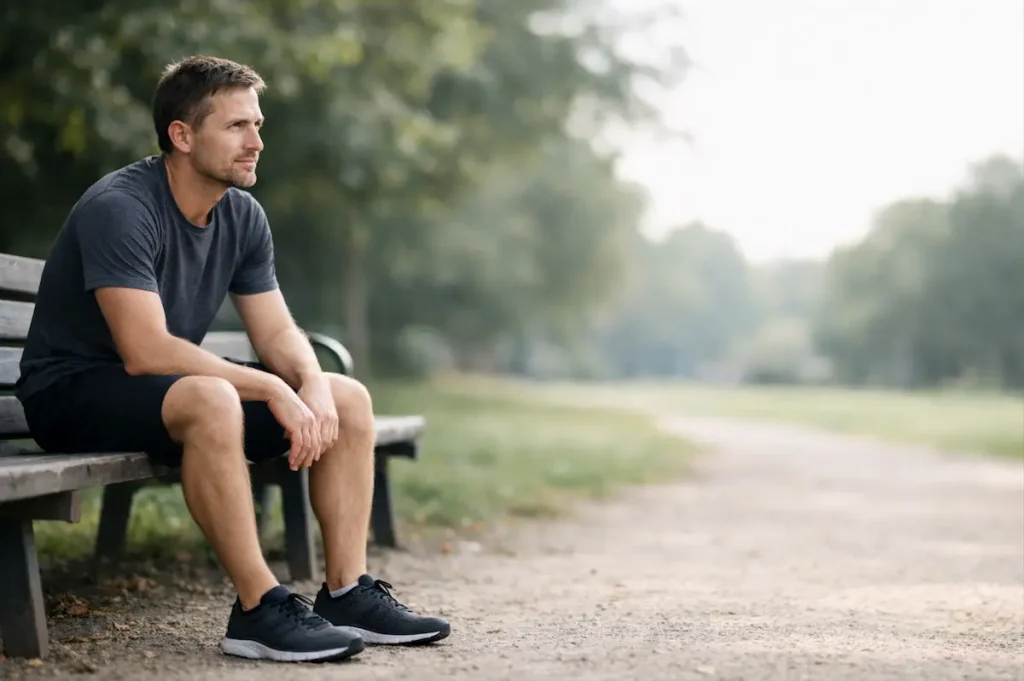
Scope: Runner-focused guidance on using sports/deep tissue massage for common overload problems – plantar fasciitis, runner’s knee/ITB-type pain, shin splints, Achilles tendinopathy, and hip/deep glute pain. The principles also apply to overload-type pain from walking, standing, gym training, or sport.
⚡ Quick Answer / TL;DR
Does massage help plantar fasciitis, knee pain, shin splints, Achilles or hip pain? It can help – mainly by reducing pain sensitivity, improving movement comfort, and calming protective tension. But it rarely fixes the root cause on its own.
Most helpful when: pain is overload-driven and you feel stiff/guarded, symptoms improve as you warm up, and there’s no swelling/heat.
Least helpful (or higher risk) when: you have sharp pinpoint bone pain, acute tendon flare-ups, significant swelling/heat/redness, nerve symptoms (numbness/tingling/weakness), or pain worsening week-on-week.
Best approach: Use massage to settle symptoms while you adjust training load and rebuild capacity (calf strength, foot strength, hip control, and gradual progression).
What Helps Fast: Massage Targets (and What to Avoid)
This is the “don’t waste your money” version. Use it to brief your therapist or guide self-massage.
| Issue | Best Massage Targets | Avoid | Do Next (for lasting change) |
|---|---|---|---|
| Plantar fasciitis heel/arch, “first-step” pain |
Calf + soleus, gentle foot intrinsics | Aggressive pressure on sore heel insertion | Reduce hills 10–14 days + calf strength 3x/week |
| Knee pain PFPS / ITB / patellar tendon |
Quads, hip flexors, glutes, calves as needed | “Smash the ITB” or dig into a flared tendon | Step-downs / split squats 2–3x/week + flatten runs 7–10 days |
| Shin splints diffuse inner shin ache |
Soleus/calf, tibialis anterior, peroneals | Deep work along a painful shin bone edge | Reduce load spike + calf/tib raises 2–3x/week |
| Achilles pain stiff start, warms up |
Calf + soleus (not the sore tendon) | Very deep friction on an irritable tendon | Progressive calf loading + reduce hills/speed 2 weeks |
| Hip / deep glute often called “piriformis” |
Glute med/min, deep rotators, hip flexors if “blocked” | Chasing one knot forever; ignore nerve symptoms | Hip control work 2–3x/week + reduce triggers 2 weeks |
Should You Get Massage for This Pain? (60-Second Decision)
- ✅ Massage is a good idea today if: it feels tight/stiff/guarded, improves as you warm up, there’s no swelling/heat, and symptoms aren’t worsening week-on-week.
- ⚠️ Massage can help, but only if you change load too: it aches during/after runs, settles with rest, then returns quickly when you repeat the same training.
- ❌ Skip massage and get assessed first if: sharp pinpoint bone pain, night/rest pain, swelling/heat/redness, numbness/tingling/weakness, or a sudden injury with a “pop”, bruising, or inability to weight-bear.
When Is It Safe to Run Again? (Simple Pain Rules)
- Pain during the run is ≤ 3/10 and doesn’t force you to change your stride.
- Symptoms aren’t worse the next morning (morning-after pain is a great “irritability” check).
- No limp afterwards and no progressive deterioration across 7–10 days.
- Progress one variable at a time: distance or speed or hills – not two at once.
Runner rule: If pain is getting worse week-on-week, it’s often load vs capacity rather than “just tightness”.
What Massage Can (and Can’t) Do for Overuse Pain
Massage is often described as “breaking down scar tissue” or “releasing tight fascia”. That language can be misleading.
In most running injury scenarios, massage helps through three realistic mechanisms:
- Pain modulation: it can reduce pain sensitivity for a period of time.
- Improved movement comfort: overworked tissues can temporarily feel looser and easier to load.
- Down-regulating protective muscle tension: particularly around the calves, hips, glutes, and lower back.
What massage usually doesn’t do on its own:
- Repair a tendon tear or cartilage issue
- Fix an overload pattern without strength work
- Reverse a bone stress injury
- Replace progressive loading and rehab
Useful mental model: Massage is a symptom tool, not the full solution. It’s most powerful when it gives you enough comfort to train (or rehab) consistently again.
How Deep Should Massage Be? (A Simple Pressure Scale)
A common mistake is assuming “more painful = more effective”. For overload issues, the opposite is often true.
- 2–4/10 pressure: acute pain, irritable tendons, sensitive shins, flared-up symptoms
- 5–7/10 pressure: stubborn tightness, overload patterns, “stiff but stable” discomfort
- 8–10/10 pressure: rarely necessary – higher risk of flare-ups and bruised tissues
Rule: If symptoms flare for > 24 hours after treatment, next time reduce pressure by 2 points and focus more on the muscle that loads the painful area (e.g., calf for Achilles/heel).
What “good” feels like after: lighter walking, smoother movement, less guarded stride – not bruised or limping for two days.
Injury-Specific Guidance (Quick, Runner-Focused)
Below are the high-impact priorities for each issue. For full rehab plans and deeper detail, use the dedicated guides linked in each section.
Plantar Fasciitis (Heel / Arch Pain)
Bottom line: Massage can reduce heel pain short-term, especially via calf/soleus work. Avoid hammering a sharp, irritable heel insertion.
Best targets: calf complex (gastroc/soleus), gentle foot intrinsics.
Avoid: aggressive deep pressure directly on the sore heel insertion (especially if morning pain is sharp).
Do next: reduce hills for 10–14 days + slow calf raises 3x/week (pain ≤ 3/10).
Knee Pain (Runner’s Knee / ITB Pain / Patellar Tendon)
Bottom line: Most knee pain responds better when you treat what loads the knee (quads/hips/calves) rather than “digging into the knee”.
Best targets: quads, hip flexors, glutes/deep rotators, calves/hamstrings as needed.
Avoid: “smashing the IT band” as the main plan; heavy pressure directly over a flared patellar tendon.
Do next: keep runs easy/flat 7–10 days + step-downs/split squats 2–3x/week.
Shin Splints (Medial Tibial Stress Syndrome)
Bottom line: Massage can help by reducing lower-leg tension – but treat shin pain cautiously because it can sit on a bone-stress spectrum.
Best targets: soleus/calf, tibialis anterior, peroneals – focus on muscle, not bone.
Avoid: deep aggressive work along a painful shin bone edge.
Do next: reduce the load spike + calf/tib raises 2–3x/week; avoid hard surfaces temporarily.
Achilles Tendinopathy / Achilles Irritation
Bottom line: For Achilles issues, massage the calf/soleus and build calf capacity – don’t make the sore tendon the punching bag.
Best targets: calf + soleus; lower-leg guarding patterns that change your stride.
Avoid: very deep friction directly on a flared tendon.
Do next: reduce hills/speed for ~2 weeks + progressive calf loading as tolerated.
Hip Pain / Deep Glute Pain (Often Called “Piriformis”)
Bottom line: Massage can reduce guarding and make your stride feel smoother fast – but lasting change usually comes from hip control + reducing triggers.
Best targets: glute med/min, deep hip rotators; hip flexors/adductors if the front of the hip feels “blocked”.
Avoid: endlessly chasing one “knot” without load/strength changes; ignore nerve symptoms.
Do next: reduce hills/speed/long sitting triggers for 2 weeks + simple hip strength 2–3x/week.
“Most pain I see in runners isn’t because of a single muscle playing up. It’s usually an overall workload problem. Massage can really help to calm things down fast, but the best results come when we pair it with a simple plan to reduce what’s irritating the tissues, build strength back up, and return to running gradually.”
– Jack P, Sports Massage Therapist based in Long Eaton
What Type of Massage Is Best for Runners?
Different massage styles create different outcomes. The best choice depends on whether you’re dealing with training fatigue, persistent tightness, or injury-related pain.
| Massage Type | Best For | What to Expect |
|---|---|---|
| Sports massage | Tightness, overload patterns, post-training soreness | Targeted, sometimes uncomfortable, function-focused |
| Deep tissue massage | Persistent tension and trigger points | Slower pressure, deeper sensations, needs good communication |
| Relaxation massage | Stress, poor sleep, nervous system overload | Gentle, calming, supports recovery and sleep |
What to Expect in a Good Session (So You Don’t Waste Your Money)
- A quick symptom check: where it hurts, what triggers it, what changed in training.
- Pressure matched to irritability: light-to-moderate when flared; deeper only when stable.
- Targets beyond the pain spot: calves/hips/quads depending on the pattern, not just the painful point.
- Aftercare guidance: what to do for the next 24–48 hours to avoid a flare.
- No pain contest: “effective” doesn’t mean bruised or limping for two days.
Self-Massage vs Professional Massage (Ball, Foam Roller, Massage Gun)
Self-massage can help for general stiffness and “background tightness”. But it’s easy to overdo it when tissues are irritable.
Self-massage works best when ✅
- You feel general tightness rather than sharp pinpoint pain
- Symptoms improve as you warm up
- You use moderate pressure (think 4–6/10)
Be cautious / avoid when ❌
- You have sharp focal bone-like pain (possible bone stress injury)
- You have nerve symptoms (tingling, numbness, weakness)
- You’re repeatedly hammering a flared tendon insertion (Achilles/heel)
Simple targeting rule: For tendon issues, massage the muscle that loads the tendon (e.g., calf for Achilles), not the sore tendon itself.
What a Good Massage Plan Looks Like (If You’re Actually Trying to Fix the Problem)
If you want results (not just a nice hour), massage works best when it supports a runner-first plan.
Step 1: Set the goal of the session
- Symptom relief: reduce pain and make walking/running feel easier
- Recovery support: reduce DOMS and muscle fatigue during heavy training
- Mobility support: improve comfort in ankles, hips, calves
Step 2: Choose the right intensity
- For acute pain: keep pressure light-to-moderate
- For stubborn tightness: increase depth gradually across sessions
- For tendon flare-ups: avoid “digging in” directly on the tendon
Step 3: Do one smart thing after the massage
- Gentle walk later that day
- Simple calf or hip strength work the next day (if pain allows)
- Reduce running intensity for 24–48 hours if the area was sensitive
Runner rule: If a massage leaves you bruised and you have to limp for 48 hours, it was too much. “Effective” does not mean “aggressive”.
When Massage Is a Bad Idea (Red Flags)
⚠️ Speak to a clinician (or NHS 111) if you have:
- Severe pain that is worsening week-on-week
- Swelling, heat, redness, or sudden loss of function
- Night pain that doesn’t settle with rest
- Shin pain in one precise spot (especially if painful at rest)
- Numbness, pins and needles, or weakness in the leg/foot
- Recent injury with a “pop”, bruising, or inability to weight-bear
Frequently Asked Questions
Does sports massage help running injuries?
Often, yes. It’s most helpful when it reduces pain and guarding enough that you can rehab consistently – while you also adjust load and rebuild capacity.
Can massage make plantar fasciitis worse?
Yes. Aggressive deep pressure on an irritable heel insertion is a common flare trigger. Most runners do better with calf/soleus work and gentle foot work.
Can massage fix shin splints?
It can reduce symptoms, but it won’t solve the cause alone. Shin splints usually improve when training load is adjusted and lower-leg capacity is rebuilt gradually.
Should you foam roll the IT band?
Usually not aggressively. Many people do better focusing on glutes, quads, and hip control rather than repeatedly smashing a sore lateral thigh. If it helps and doesn’t flare symptoms, keep pressure moderate.
Should you massage the Achilles tendon directly?
Usually not aggressively. Most people benefit more from calf work and progressive loading, with careful pressure choices around the tendon.
How often should runners get sports massage?
Most people do well with every 3–6 weeks for maintenance. For injury support, weekly or fortnightly sessions for a short block can help while rehab is underway.
Summary
- Massage can help plantar fasciitis, knee pain, shin splints, Achilles tendinopathy, and hip/deep glute pain – mainly by reducing pain sensitivity and improving movement comfort.
- It rarely fixes the underlying cause on its own. Load management and strength still matter.
- Avoid aggressive treatment on highly irritable tendons or sharp, focal shin pain.
- Use massage as part of a plan: settle symptoms, rebuild capacity, return to activity gradually.
Related Guides (Recommended)
- Sports Massage vs Deep Tissue: What’s Best for You?
- What To Wear To A Sports Massage
- How Often Should You Get a Sports Massage
Medical Disclaimer: This article is for educational purposes and is not a substitute for medical advice.